The Learning Game
A reflection on the gap between recognising knowledge and truly understanding it—and why effort, failure and persistence are essential to learning.


Cox_skates is undefeated, top of the leaderboard; in real life, he's never once stood on an actual skateboard. Hand him one, and he lasts about four seconds before gravity takes over!
It's a strange little contradiction, but it's not really about skating. It's about two very different things that both feel like knowing how to do something until one asks which one actually holds up once the screen is gone.
In the language of learning research, this gap has a name: surface learning versus deep learning, first described by researchers Ference Marton and Roger Saljo back in the 1970s. Surface learning is about reproducing something: the fact, the move, the correct answer; "knowing" it well enough to recognize or try repeating it. Deep learning is about actually using the "understanding" to build it into something one can use: adjust, explain, apply somewhere new, do it again under pressure. Both can look identical from the outside. Only one of them survives contact with reality.
Recognizing the right answer is cognitively lower order. Our brain barely has to work; it just matches what's in front of us to something familiar. That's what the screen skating game gives us: the feel of mastery, minus the actual physical effort of falling, wobbling, catching yourself, falling again. Real skating asks our body to build balance the slow way, through failure. The screen game skips straight to the reward.
"Winning" in the screen game means timing the button press. "Winning" on real skates means our body learned to balance, to fall well and overcome fear. Same word — completely different thing being measured.
I often see students describe this with honesty, if you listen attentively. When a child is asked to explain/write out their thinking, rather than just pick the right answer, and you'll often hear some version of: ahhh!! no!! it's a lot… It hurts my brain. That's not a complaint to brush off, it's an accurate report. Writing, explaining, and working something out from scratch are what researchers call "generative" acts. One has to produce the thought themselves, rather than just recognize it. That's genuinely harder. The discomfort during generative tasks isn't a sign something's gone wrong. It's a sign that real work is happening.
This shows up well past academics, too. A young dancer can watch a routine once and describe every step back perfectly and still stumble the moment she may have to actually perform it, because naming the steps and performing them physically are two very different things. A student can hum a melody back note-for-note after listening to it once, and still be nowhere close to actually playing it. In every one of these, there are two things that feel like competence: recognizing what mastery looks like, and being able to produce it on one's own, in real situations. Only the second one is real.
Today, answers, techniques, "how it's done", are all one search away, in a form fluent enough to feel like understanding. It isn't. It's familiarity showing up like understanding.
It takes a bridge to move from knowing to understanding and “effort” is that bridge. Crossing it feels uncomfortable, even like failing, at first. But it's persistence that carries one across, until what once felt shaky starts to feel like solid ground.
That's the whole difference between Cox_skates and a real skater. It's just about the will to try, fall first and get back up, which, it turns out, is most of what learning looks like!


“Oh! You’re a teacher! You must be so serious and strict!” These are words I hear whenever I meet someone new. I never know how to explain this in words, because if one hasn’t been on this side of the classroom, one cannot fathom what it truly means to be a teacher.
What I’d like to tell them is that to be a teacher is to be a fool.
You have to realize that you’re not teaching English, or math, or science, or economics, or DP or MYP. You are teaching someone’s child. You’re teaching their hope, their life.

You have to realize that “doing well” doesn’t mean scoring 99% or an A or behaving perfectly. It means having small ‘light bulb’ moments in class when their face and eyes light up because they have finally understood something. It means old students telling you they remember your subject years after you’ve stopped being their teacher. It means seeing your students do better and bigger things than you. Those are moments when the teacher earns an ‘A’.
Indeed, a large part of being a teacher is being foolish. You have to be foolish enough to believe in each and every child that can learn, despite what anyone says. Foolish enough to know that learning comes in waves for some, smoothly for others. For some, it may even come in the last week you have them in your class. Foolish enough to show the child you believe in him/her, even when they have lost faith in themselves. Foolish enough to teach the same topic differently. Through words, pictures, videos, activities or even stand-up comedy and speaking gen-Z vocabulary, internally celebrating the moment when finally something clicks.

WHY? Because unless the teacher leaves the ‘throne of knowledge’ and comes down to the learning level of the child, true learning can never happen. From the throne, we can only look down upon others, we can only judge them, we can only feel superior. When you sit beside the child, we become equals, we can actually see them as individuals, experience their struggles, feel their frustrations and fears. From the throne, we can only show “You must be like me”, sitting beside them, you can say “I also feel scared, unsure and lost at times.”
Yes, this means that many times you have to let go of the lesson plans, deadlines and assessments. You may not have the ‘pin-drop silence’ class from the 1980s where everyone gives the right answers and takes beautiful notes. Your class may have a sort of organized chaos. To someone walking past your class, it may look like mayhem mixed with indiscipline. But the reward is that you get to laugh with the child placed in your care, know what they love, empathize with them, even cry with them! You get to know them as people!

To the teachers who can make a fool of themselves in the eyes of the bystander, I say, you will always win. Because you have found that the key to a child’s mind is to unlock his/her heart and free their spirit.
May we all be able to stop and breathe and reconnect with the child within us. May we be brave enough to make a fool of ourselves for a moment, laugh freely at ourselves, apologize genuinely when we make mistakes, look deeply at a child so they feel truly seen, acknowledged and valued. Because to be a teacher is to be a fool… a hopeful fool!
“The greatest lesson in life is to know that even fools are right sometimes.”
Winston S. Churchill


Nobody has ever thanked me for a bus that arrived on time.
That isn't a complaint. It's the job. Most of my work only becomes visible when it fails — the washroom that isn't clean, the jersey that didn't arrive before the match, the first-aid kit that was short of something. When it goes right, it disappears. A student walks through an entire school day without once having to think about how any of it got there.
I've come to believe that disappearing is the point.

By the time the first students arrive, a fair amount has already happened.
Transport is usually first. Routes, timings, a change in a family's pick-up point, a driver caught in traffic, a parent who needs to know where the bus has reached. A bus arriving safely and on schedule looks like the most routine thing in the world. Making it routine is not routine at all.
Then the campus has to be ready. Housekeeping, security, facilities, the cafeteria, the infirmary — each team has its own morning, and a lot of my job is being the thread between them. Someone has to notice the thing that would otherwise be nobody's particular responsibility. Usually that is me.
The largest part of my week is getting things to the people who need them.
It rarely looks the way people assume. A teacher raises a requirement. We find suppliers, ask for quotations, compare them, check the specifications against what was actually wanted, get approvals, place the order, and then follow it through production and delivery until the thing is physically in the right hands.
Sometimes that takes a week and goes smoothly. Sometimes stock runs out, the requirement changes halfway, the timeline shortens, and the plan I made stops being useful. That is the part of this work I have had to learn — not how to follow a process, but what to do when the process no longer fits.

Working in administration has changed what I see when I walk across campus.
A clean washroom. A stocked first-aid kit. A uniform available on the day a student needs one. A certificate printed correctly. A visitor guided to the right place instead of left standing in a corridor. A team that has the equipment it was promised.
None of these matters much on its own. Together they are most of what it actually feels like to be in a school.
So a good part of the job is simply looking. Listening when somebody mentions something in passing, before it becomes a complaint. Asking whether a thing that has always been done a certain way is still the right way to do it.
A field trip, a sports fixture, an inter-school competition. To a student it is one day. Underneath it there is transport, timings, permissions, food and water, equipment, security, housekeeping, communication, half a dozen vendors, and a plan for what happens if any one of those falls through.
Then something falls through anyway, and you deal with it while the day carries on around you.
The satisfaction comes from watching students enjoy something with no idea what it took. That is not a small feeling. It is the entire feeling.

Here is what I have slowly worked out.
A student who has to wonder whether the bus will come, whether the equipment will be there, whether the room will be usable, is spending attention on things that have nothing to do with learning. Attention is finite. Every question we answer before anyone has to ask it is attention handed back.
That is what the work is for. Not tidiness. Not efficiency. Concentration.
When teachers have what they need, they teach. When transport runs, families begin the day without anxiety. When the campus is ready, a student's whole attention is available for whatever they are actually here to do.
None of it shows up anywhere. It isn't meant to.
That is the reason to do it carefully.


“Mathematics is a subject that is all about creativity, making connections, and sense-making.”
— Jo Boaler
When students can see the maths, they can talk about it.
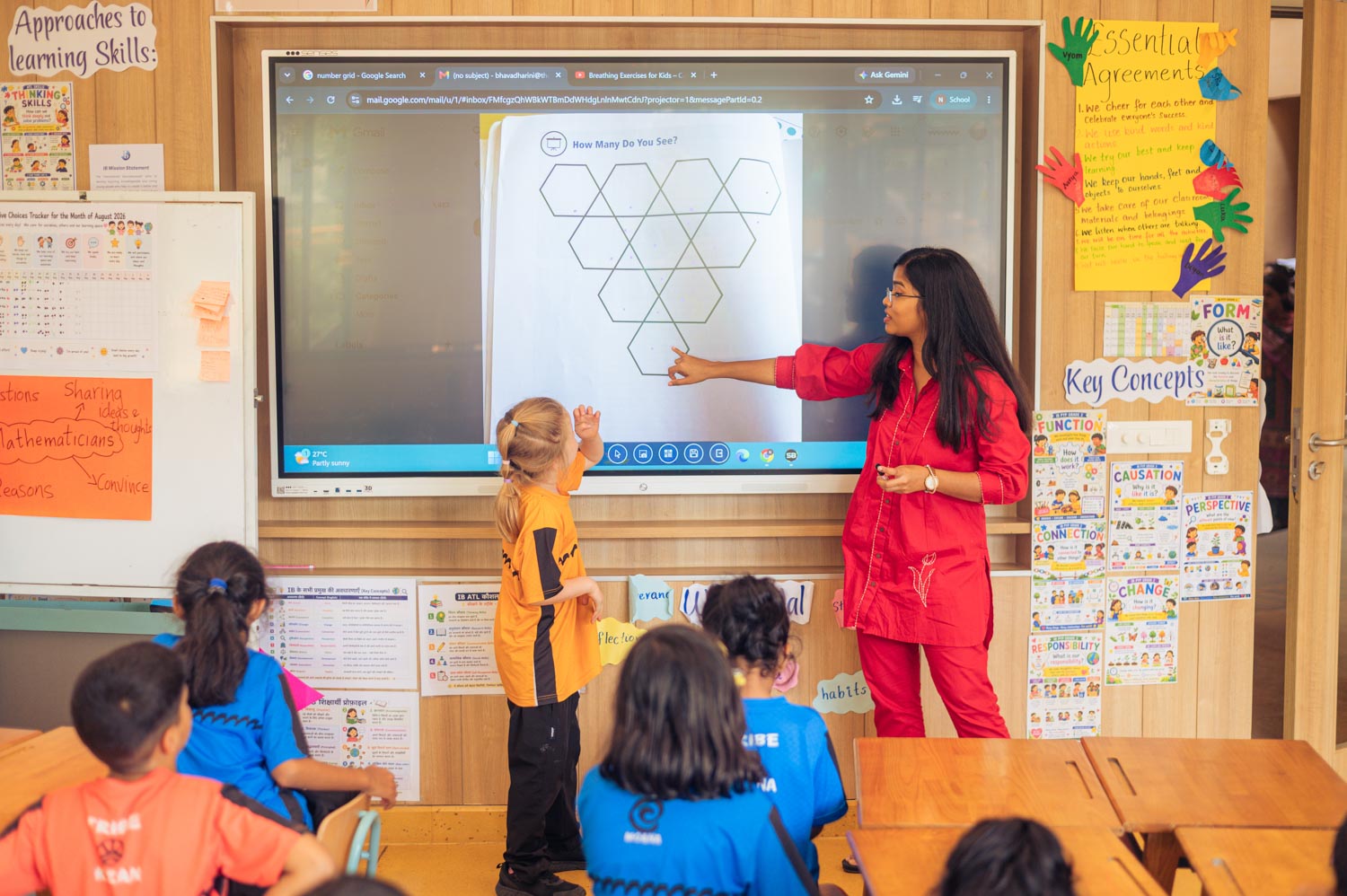
This became the core idea behind our Grade 2 Math Talk journey. It started with simple but intriguing mathematical images—dot patterns, tens frames, number lines and visual models—and invited students to look closely before looking for an answer. We wanted them to notice the mathematics, make connections and find a way to communicate what they were seeing.
In mathematics, the final answer can sometimes hide the thinking that produced it. Two students can arrive at the same answer while seeing the mathematics in completely different ways. One might count, another might group, another might partition, while another might recognise a relationship immediately. We wanted Math Talk to open up those different ways of seeing.
We wanted students to experience the jobs of mathematicians—to explain, justify, convince, reason and share. The focus was not simply on whether students could solve a problem, but whether they could communicate the mathematical thinking behind their solution.
The representations became particularly powerful because they helped make mathematical relationships visible. Students could see quantities, structures and connections that might otherwise have been difficult to hold in their minds.
Instead of carrying several relationships mentally, they had something in front of them that they could return to, manipulate and compare. This helped reduce some of the cognitive load involved in working with multiple pieces of mathematical information at once.
The visual was not there to make the mathematics more attractive.
It was there to make the mathematics easier to see and think about.

Once students had something they could see and work with, we needed to give them the language to communicate their thinking. We intentionally introduced mathematical vocabulary such as partition, compare, represent, strategy, justify, reason and convince.
These words were not introduced simply for students to remember. They became part of the way students communicated mathematical relationships and explained their choices. Their explanations began to move beyond what they had done towards why they had done it.
This connected strongly with Jo Boaler’s emphasis on mathematical reasoning. Explaining mathematical work is not something that happens after the mathematics; it is part of the mathematics. A correct answer could tell us where a student had arrived. Their explanation helped us understand how they had got there.
As Math Talk developed, we began listening beyond the final answer. Could students explain a relationship? Could they justify a strategy? Could they use evidence to support their thinking? Could they compare different approaches and explain what they noticed?
The jobs of mathematicians began to become part of the mathematical work itself. Students were explaining, justifying, convincing, reasoning and sharing ideas that could be examined. An answer could become the beginning of another question rather than the end of the task. A strategy could be challenged. A representation could reveal something unexpected. Students could return to the mathematics and ask:
“What makes this make sense?”
What Happens When the Answer Doesn't Work?
Some of the richest moments came when students were unsure. A strategy might lead to an unexpected answer, a representation might reveal something they had not anticipated, or a problem might reach a point where they did not know what to try next.
Instead of immediately providing another procedure, we gave students time to stay with the mathematics. They could return to the representation, rearrange the objects, redraw the model, adjust the number line or try representing the problem in another way. Gradually, students became more willing to remain in that uncertainty. They tried another possibility, reconsidered an earlier idea and continued working when their first approach did not succeed.
This changed the way we looked at mistakes too. An unexpected answer could reveal something about how a student was thinking. Rather than treating the mistake only as something to correct, we could use the representation to investigate the reasoning behind it. Jo Boaler’s idea that “Every time a student makes a mistake in math, they grow a synapse” resonated with this approach. The value was not in making a mistake, but in what the mistake allowed us to investigate.

Another idea from Boaler resonated strongly with our experience: some mathematicians are not particularly fast with numbers because they “think deeply and carefully about mathematics.” This challenged the assumption that speed is a measure of mathematical ability. Math Talk created space for students to pause, look again, represent an idea and reason before moving forward. Sometimes, slowing down was what allowed students to see something they had missed the first time.
As students became familiar with different representations, they began to recognise that the same mathematical idea could look different depending on how it was represented. A tens frame might reveal composition. An open number line might make jumps and relationships visible. A drawing might expose the structure of a problem. An equation might express the same relationship symbolically.
This led to an important question:
What does each representation help us see?
Students began to understand that representations were not simply different ways of recording an answer. Each could reveal something different about mathematics.
The next question was whether these ways of thinking would transfer when the mathematical context changed. We began noticing students using mathematical practices in situations that did not look exactly like the examples they had encountered before. They could represent an unfamiliar problem, look for relationships and draw on reasoning even when a familiar procedure was not immediately available.
Transfer was not simply remembering a strategy. It was knowing when mathematical thinking could help.
This was also where we began to see students making more decisions within mathematics. They could consider which representation might help, how they could show their thinking and which strategy might make sense for the problem in front of them.
They were not simply waiting for the next instruction.
They were beginning to decide how to enter mathematics.

Looking back, the shift was not simply about students talking more. It was about giving students more ways to see, represent and reason about mathematics. The visual representation gave mathematical thinking a form. Language helped students articulate it. Math Talk gave them a space to examine it. Difficult moments gave them opportunities to revisit and rethink. Different representations opened possibilities for mathematical choice, and these practices began to travel into new situations.
What began with mathematical provocations and visual representations gradually became a different way of approaching mathematics. Students were not only looking for an answer; they were looking for relationships, making sense of what they saw, explaining their choices and deciding how they wanted to approach a problem.
Ultimately, the question is not simply, “Can the child get the answer?”
It is: “Can the child see mathematics, make sense of it, represent it, explain it, justify it, convince others and reason about it?”
Because when students can see the maths, they can talk about it. And when they can talk about it, they can begin to do the jobs of mathematicians.