Self Management Skills
Discover practical time management tips for students. Learn how to beat procrastination, stay organized, and build lifelong self-management skills.


This journey of lifelong learning with my time in the IB curriculum has taught me that the most effective self-managers are those who understand themselves — their energy, their tendencies, and their triggers — as much as they understand their tasks.
Self-management is often reduced to time management tips: use a planner, break tasks into chunks, avoid your phone. These are useful. But they miss something deeper. True self-management is about developing the metacognitive awareness to know when you work best, what derails you, and how to recover when things go sideways.
In the MYP, self-management is one of the five Approaches to Learning skill clusters. It encompasses organisation, affective skills (managing your emotions and motivation), and reflection. We teach it explicitly — not as a one-off lesson, but woven into the fabric of daily learning.
Procrastination is not a character flaw. It is usually a response to anxiety, overwhelm, or a task that feels too large or too vague. When students understand this, they can address the root cause rather than just criticising themselves.
We teach students to ask: What specifically is making this feel hard? Is it the size of the task, the fear of getting it wrong, or the fact that I don’t know where to start? Once the obstacle is named, it becomes manageable.
At Raya, we ask students to reflect regularly — not just on what they produced, but on how they worked. What strategies helped? What would they do differently? Over time, this builds a self-awareness that is far more valuable than any single study technique.
Students who develop strong self-management skills don’t just do better in school. They navigate adulthood more gracefully — adapting to new demands, recovering from setbacks, and continuing to grow long after the final exam.


The world no longer asks for answers that fit neatly into boxes. It asks for people who can sit with complexity, notice patterns, and move comfortably between logic and imagination. Today’s challenges — climate change, mental health, technology ethics, food security — don’t belong to one subject. They belong to everyone.
At The School of Raya, we believe that interdisciplinary learning is not a trend. It is a necessity.


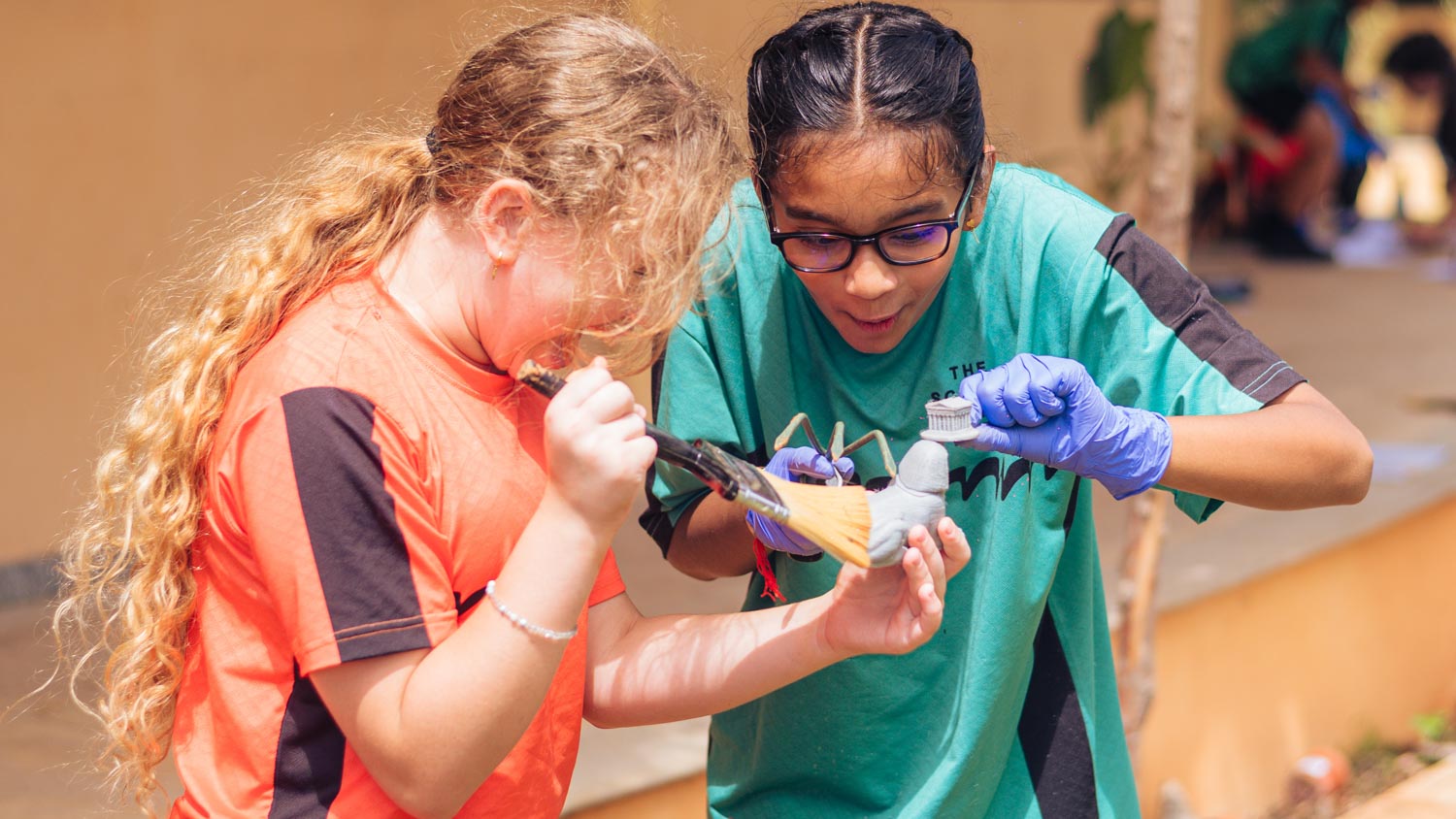
In our Visual Arts classroom, students don’t just paint or sketch. They investigate. A recent unit had students exploring bioluminescence — the science of light produced by living organisms. What began as a biology concept became a design challenge: How do you represent invisible light? How do you make people feel wonder?
Students researched the chemistry, sketched organisms under microscopes, and created large-format paintings that captured both scientific accuracy and emotional resonance. The result was work that neither a pure science class nor a pure art class could have produced alone.
Interdisciplinary learning works because curiosity doesn’t respect subject boundaries. When a student asks why van Gogh painted the way he did, the answer pulls in neuroscience, history, mental health, and colour theory. When they ask how music affects mood, they’re touching psychology, physics, and culture simultaneously.
We lean into those moments. We follow the question wherever it leads.
Students who learn across disciplines develop the ability to transfer knowledge — to take a concept from one domain and apply it meaningfully in another. They become comfortable with ambiguity. They learn that not knowing is the beginning of inquiry, not a failure.
They also develop empathy. When you study a problem from multiple perspectives — historical, scientific, artistic, ethical — you begin to understand that most real issues are genuinely complex. That understanding changes how you engage with the world.
The future belongs to people who can think across boundaries. We are building those people, one question at a time.


Long before anyone else could see it, a quiet story was already taking shape in his mind. He was a student who loved art. Not just as a subject, but as a way of thinking. He sketched in the margins of his notebooks, stayed back after school to work on designs, saw the world in lines and patterns, and found comfort in creating. As high school progressed, the questions grew louder: What next? What will you choose?
Architecture seemed like the obvious path, where his love for art could meet something more structured. But the decision did not come easily. His teachers saw his potential and strongly encouraged him, while at home, his parents held on to dreams of stability and recognition for him. In the middle of all these voices, his own felt the quietest present, but often unheard.
Through conversations and stories of others who had navigated similar crossroads, he began to pause and reflect: Do I see myself doing this every day? Will I still have space for my creativity? Is there a way to choose both structure and freedom?
Instead of rushing, he started exploring universities that offered architecture with room for artistic expression, places where his passion did not have to be left behind. Slowly, the decision became clearer. Not because someone told him what to do, but because he could see himself in that path.
Years later, as an architect, he invited me to his art exhibition. It was his dream come true. Not just to become an architect, but to build a life where his creativity still had space and meaning.


Before a good decision comes self-awareness. In my experience as a guidance counselor, students rarely struggle because they don’t have options — they struggle because they haven’t yet understood themselves within those options. This is where stories begin to matter. At The School of Raya, students engage with their stories — their unique experiences, a moment of choice, a path taken or not taken — and naturally begin to turn inward.
This reflective pause is powerful. It allows Rayots to move beyond immediate reactions and start recognising their own values, fears, and motivations. Over time, patterns begin to emerge — what excites them, what holds them back, what truly matters.
In adolescence, the part of the brain responsible for reasoning and long-term thinking is still developing, which is why decisions can feel emotional, uncertain, and sometimes impulsive. But this is not a weakness — it is part of growth.
This is where self-awareness begins — by looking inward, by making sense of one’s own experiences, values, and expectations. Through conversations, reflective questions, and shared narratives, students begin to see patterns in their thinking and choices. The IB learning environment further supports this process by encouraging reflection, inquiry, and perspective-taking.
Because in the end, good decisions are not made in pressure-filled moments. They are built over time — through stories, experiences, self-awareness, and the quiet courage to choose a path that feels true.


“Adopt the pace of nature: her secret is patience.” — Ralph Waldo Emerson
In a world obsessed with speed, instant downloads, quick answers, and fast results, patience may seem outdated. Yet, it is one of the most powerful qualities a student, teacher, or parent can cultivate. At The School of Raya, we have come to see patience not as passive waiting, but as an active, intentional practice.
We live in an era where everything feels urgent. Students are asked to choose careers before they have truly experienced life. Parents measure progress in grades and rankings. Teachers face pressure to cover curriculum faster than understanding can settle. In this environment, patience becomes an act of quiet resistance.
But the research is consistent: deep learning takes time. Mastery requires repetition, reflection, and rest. The brain consolidates understanding not in the moment of instruction, but in the spaces between.


At Raya, patience shows up in many forms. It is a teacher sitting with a student’s confusion rather than rushing to provide the answer. It is a student returning to a piece of writing five times before it finally says what they meant. It is a parent trusting the process even when progress is not immediately visible.
It is also institutional. We design learning experiences that unfold over time — projects that span weeks, units that revisit ideas from multiple angles, assessments that ask students to demonstrate understanding rather than recall information.
Some of our most meaningful breakthroughs happen not in moments of instruction but in moments of struggle. When a student sits with a problem long enough, something shifts. They stop looking for the shortcut and start looking for understanding. That is where resilience lives.
We tell our students: the discomfort you feel when something is hard is not a sign that you are failing. It is a sign that you are growing. Learning to stay present in that discomfort — to be patient with yourself and with the process — is one of the most important skills we can develop.
Meaningful growth happens when we trust the process, stay present, and allow time to do what only time can do.